

Sculpt Your Silhouette: Buttock & Hip Liposuction
Our doctors utilize advanced liposuction techniques, and we offer precise fat transfer techniques and SmartLipo technology to create natural-looking curves where you desire them most, enhancing your shape while maintaining harmony with your natural proportions.
You’ll feel confident from every angle.
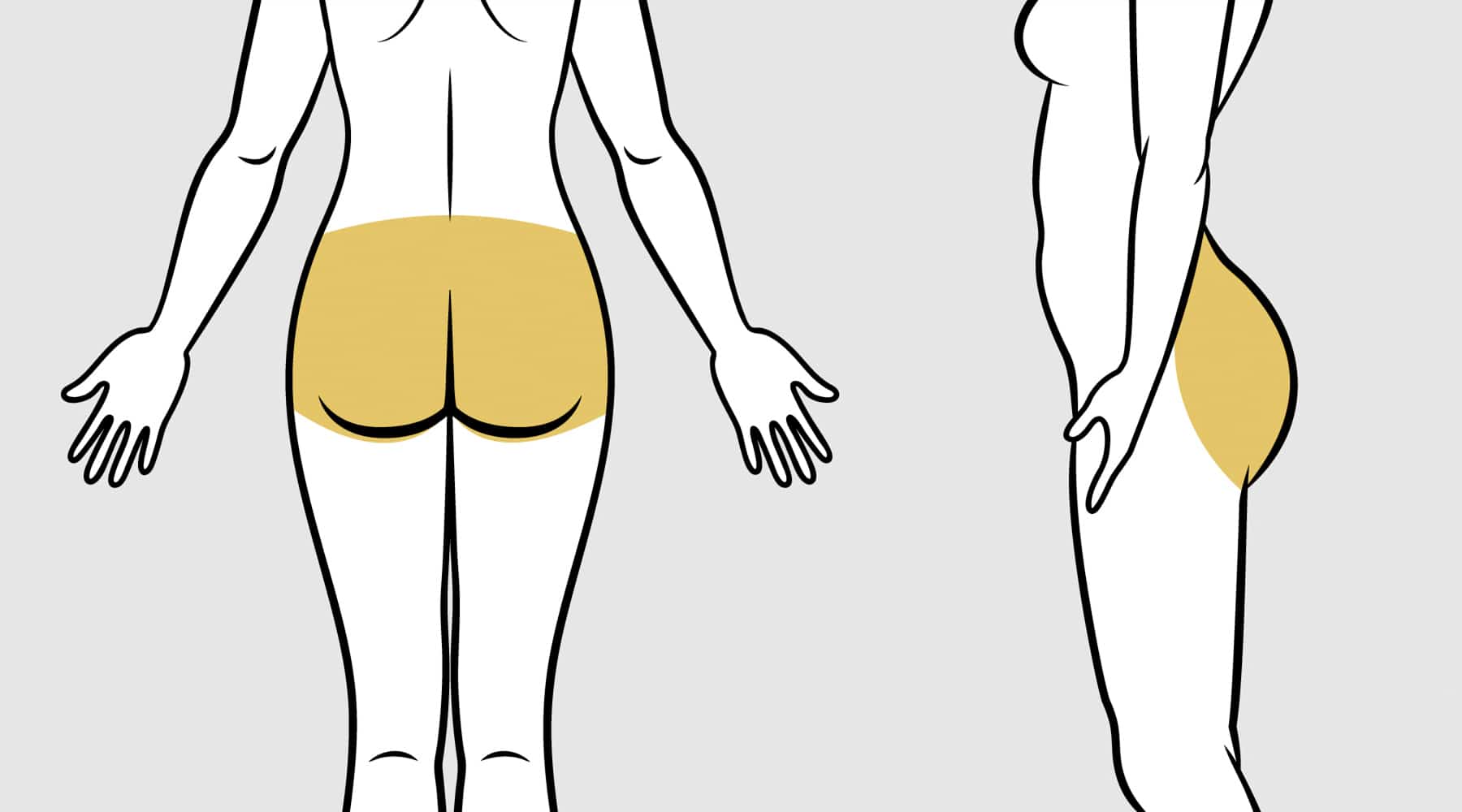
What Buttock and Hip Liposuction Treats
Fat around the hips, the outer buttock and the crease where the buttock meets the thigh is often the last to respond to training. Stubborn fat describes deposits that stay put despite consistent diet and exercise, and where your body stores it is influenced heavily by genetics and hormones rather than by effort.
Buttock and hip liposuction removes those deposits directly, reshaping the outline rather than reducing your overall weight. Commonly treated areas include the hips and flanks, the outer thigh and buttock junction that widens the silhouette, and the banana roll — the pad of fat that sits between the lower buttock and upper thigh. The banana roll is a delicate area, and care is needed there to avoid disturbing the support beneath the buttock.
This is a contouring procedure, not a weight loss method. It is most useful when your weight is stable and one area is out of proportion with the rest of your frame.
Removing Fat or Adding Volume? The Question That Decides Your Procedure
This is the single most important thing to settle before booking, because the two most popular buttock procedures do exactly opposite things.
Liposuction removes fat. It makes an area smaller and smoother, and it is the right choice if your hips feel wide, your outer thighs flare, or the area beneath the buttock looks heavy.
A Brazilian Butt Lift adds fat. Fat is harvested from elsewhere — usually the abdomen or thighs — and transferred to the buttock to build projection and roundness. If a fuller, rounder shape is what you are after, removing fat from the buttock moves you away from that goal. Our guides to modern BBL techniques and to butt injections versus BBL cover that route instead.
The two are frequently combined, and that is where the confusion comes from: fat removed from the flanks or thighs during liposuction can become the material used for augmentation somewhere else. One procedure, two opposite effects in two different places. Knowing which effect you want, and where you want it, is what makes a consultation productive.
Why Skin Quality Often Decides the Result
Fat is only half the picture. The skin over it has to retract once volume is taken away, and how well it does that depends on collagen and elastin — the proteins that give skin its firmness and spring. Production of both declines with age, which is why skin can begin to look crepey or loose even when nothing else has changed.
Several other factors shape the area over time. Gluteal muscle can weaken and flatten when it is not being loaded regularly. Fat can redistribute away from the hips and buttocks, reducing volume. Repeated weight gain and loss stretches the skin and affects its elasticity. Shifting estrogen levels influence both skin firmness and where fat is stored.
Two practical consequences follow. First, resistance training genuinely helps the underlying shape — glute bridges, Romanian deadlifts, donkey kicks, step-ups, squats and lunges all build the muscle that supports your curves — but no workout tightens loose skin. Second, if laxity rather than volume is the main issue, removing more volume on its own may not improve the contour.
Where skin tone is a limiting factor, Renuvion can be paired with liposuction. It combines radiofrequency energy with helium plasma to contract tissue and to stimulate collagen production over the months that follow.
How the Procedure Works at Imagen
Buttock and hip liposuction at Imagen is performed awake, using tumescent local anesthesia. A dilute anesthetic solution is placed into the fatty layer, numbing the area and firming the tissue so that fat can be removed evenly. You stay comfortable and responsive throughout, and general anesthesia and a hospital setting are avoided entirely.
For the buttocks, access points are placed in natural creases of the gluteal fold, where they heal inconspicuously. Depending on the contour goals and your skin quality, SmartLipo laser-assisted technique or SAFR Lipo may be selected to sculpt and refine the area.
What Recovery Looks Like
A compression garment is worn over the treated area to control swelling and to help the skin settle against its new contour. Wearing it as directed does more for the final shape than almost anything else you do in the early weeks.
Light movement is encouraged early on, because walking supports circulation and helps swelling drain. More demanding training, and anything that puts direct pressure or strain through the buttock, is reintroduced gradually rather than all at once.
Swelling and bruising are expected and settle over a period of weeks. Numbness in the treated area is also common; it resolves gradually and can take considerably longer to disappear than the visible swelling does. The shape at two weeks is not the shape you keep — it continues to refine as swelling resolves. Individual results vary.
Our week-by-week liposuction recovery guide covers the timeline in more detail.
Is Buttock Liposuction Right for You?
Often it is not, and it is worth saying so plainly. This procedure is a poor fit if:
- You want a fuller or rounder buttock. Removing fat moves you further from that goal, not closer. A BBL is the procedure that adds shape.
- Loose or sagging skin is your main concern. When skin has lost elasticity, taking volume out from underneath it can make sagging more obvious rather than less. Our guide to treating saggy buttocks sets out the options that address laxity directly.
- Dimpled skin texture is what bothers you. Dimpling is caused by fibrous bands tethering the skin downward, not by the volume of fat above them. Removing fat does not release those bands.
- Your weight is still moving significantly. Results are judged against a stable baseline, so it is usually better to finish a weight loss process before contouring.
If one of these describes you, that is useful information rather than bad news — it means a different treatment fits your goal better, and a consultation is the fastest way to identify which.
Buttock and Hip Liposuction in Omaha
Imagen Body Sculpting & Cosmetic Center is located at 10404 Essex Court, Suite 100 in Omaha, and body contouring here is performed under awake local anesthesia across the full range of treatment areas, including the thighs and the wider liposuction menu.
The most useful next step is an in-person assessment, where skin quality, fat distribution and your actual goal for the shape all factor into the recommendation. Schedule a consultation to talk it through.