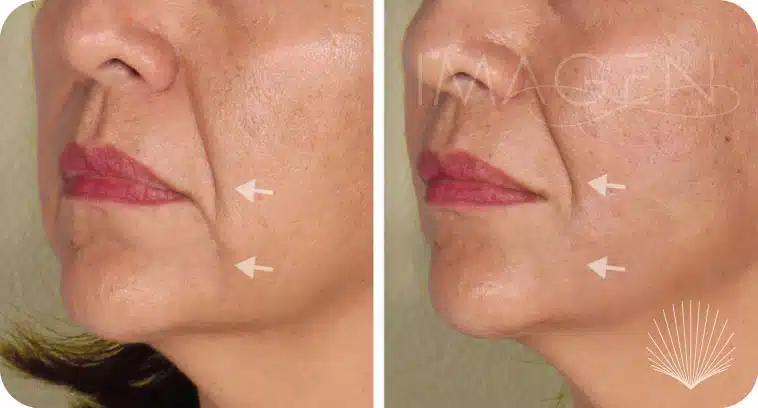

Transform your appearance without surgery through our advanced PDO Thread Lift treatments, the celebrity-endorsed secret behind today’s most coveted facial contours. Our expert physicians deliver personalized care that enhances your natural beauty, creating subtle yet striking improvements to help you achieve that coveted “snatched” jawline and lifted appearance.
Experience the confidence that comes with entrusting your beauty journey to Imagen’s expert specialists, where your unique facial structure guides our approach to create naturally beautiful results. Each thread placement is meticulously planned to complement your features, offering the transformative effects of a surgical lift with minimal downtime and maximum comfort.
What Are PDO Threads?
PDO Threads have rapidly become a popular minimally invasive alternative to surgical facelift and neck lift procedures. Thanks to celebrities such as Bella Hadid and Kendall Jenner, the procedure has given rise to the emerging cat eye, V-line and snatched jawline beauty trends!
Mechanically, a PDO thread lift is straightforward. Thin absorbable threads are placed into the skin, and the skin responds to them the way it responds to anything it needs to repair around: by producing collagen. That collagen is what holds the lift once the threads themselves have dissolved. The immediate effect is a lifting and repositioning of the tissue; the lasting effect is the collagen laid down underneath it.
It is worth being clear about what threads do and do not do. They produce subtle contouring, not a surgical result, and the effect is usually built over more than one treatment rather than delivered in a single visit. What they offer in exchange is minimal downtime and no incisions. If you want a dramatic structural change rather than refinement, threads are the wrong tool, and the consultation is where that gets said plainly rather than discovered afterwards. Individual results vary.
Threads Alongside Your Other Options
Threads are rarely the only route to a given result, and they are frequently not the best one. Skin tightening with Renuvion, chin and neck liposuction, and surgical lifting all address overlapping concerns from different angles, and which of them fits depends on how much of the problem is skin, how much is fat and how much is the underlying structure. Our physicians compare those options side by side in how to get a more defined jawline.
Threads, Materials and Where They Are Placed
The threads themselves are medical-grade and absorbable. Most are made from polydioxanone — PDO — the same soluble material long used for temporary sutures, and they are placed beneath the skin rather than through an incision. Once in position they act as scaffolding: they hold tissue where it has been lifted, and as the body works to absorb them it lays down collagen along the same lines. Poly-L-lactic acid threads are also used and tend to last longer, though they take more time to show their effect.
Thread length changes what a placement can do. Longer threads offer more support and suit larger areas such as the neck, while shorter threads are better suited to smaller, more delicate adjustments around the brows or the outer corners of the eyes. That is why one procedure name covers quite different treatments — a neck placement smoothing loose skin along the jawline, a brow placement lifting a heavy or dropped eyebrow, or the eye-corner placement behind the cat eye and fox eye looks. Material, thickness and length are all chosen against the area being treated and the result you are after.
How Long a Thread Lift Lasts
Thread lift results are not permanent, and they generally hold for one to three years. The reason is straightforward: the threads dissolve. As they are absorbed, the mechanical support they provided goes with them, and what remains is the collagen the body produced around them. That residual collagen is why the effect fades gradually rather than switching off.
Because of that, threads are better understood as something you maintain than as something you do once. Many patients return for a repeat treatment every twelve to eighteen months to hold the lift where they want it. If you would rather not commit to a repeating treatment, that is worth raising at the consultation, because it points toward different options rather than toward threads. Individual results vary.
Recovery and the Days Afterwards
A thread lift is done under local anesthesia. The area is numbed, you stay awake and alert throughout, and there is no general anesthetic and no operating-room time — the same awake, office-based approach we take across our procedures. The placement itself is quick, and most patients are back to normal activities shortly afterwards.
Mild swelling and bruising are the usual after-effects, and they typically settle within about a week. For the first couple of weeks it helps to keep the treated area undisturbed: avoid strenuous activity and heavy lifting, skip facial and neck massage and similar treatments, and sleep with your head elevated to limit swelling. The reasoning behind all of it is the same — the threads need to stay where they were placed while the tissue settles around them.
Who a Thread Lift Suits — and Who It Does Not
Threads work best on early laxity. Most good candidates fall somewhere between their mid-thirties and mid-fifties, at the stage where skin has begun to lose firmness and no longer springs back the way it once did, but where there is still enough underlying structure to lift against. They are also a reasonable route for someone who wants a visible refinement without an operation.
Threads are the wrong choice if what you want is a dramatic structural change. They produce subtle contouring, not a surgical result, and someone with substantial loose skin will usually be better served by surgical lifting or by a skin-tightening approach such as Renuvion. It is far better to hear that at the consultation than to discover it afterwards. Our physicians set out how the non-surgical routes compare in neck lift alternatives and non-surgical neck lift options, go deeper on the mechanics in how thread lifts work for facial rejuvenation, and weigh the eye area specifically in blepharoplasty compared with thread lift.
Thread Lift or Sculptra? Lifting Versus Rebuilding
These two are compared constantly, and they solve genuinely different problems. A thread lift is mechanical. It physically repositions tissue that has descended and holds it there, and the lift is visible straight away. Sculptra does nothing mechanical at all — it is an injectable that stimulates your own collagen production, and it rebuilds volume gradually over months rather than lifting anything on the day.
So the useful question is not which is better, but what has actually changed in your face. If the problem is descent — skin and soft tissue sitting lower than they used to along the jawline and neck — threads address that directly. If the problem is deflation — hollow temples, flattened cheeks, a face that reads tired rather than fallen — then repositioning will not restore what is no longer there, and a collagen stimulator is the better tool. The two are not rivals, and where both descent and volume loss are present they are often planned together.
Expert Care, Exceptional Results
Imagen’s board-certified surgeons deliver personalized attention and outstanding outcomes. We take the time to understand your aesthetic goals and develop a plan tailored specifically to you. Experience the difference that expertise makes.