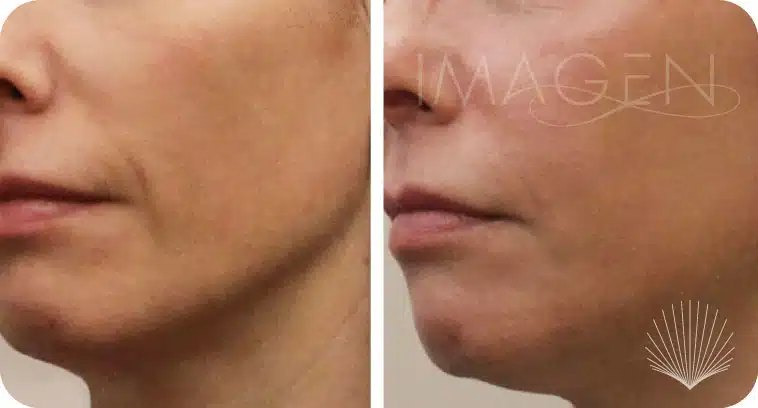

At Imagen, our expert physicians use Sculptra to stimulate your body’s natural collagen production, creating subtle and transformative results that reveal your most confident self. Your personalized treatment journey begins with doctors who see the unique beauty in your face.
Experience the difference of a rejuvenation approach that works beneath the surface, gradually restoring what time has taken away. Schedule your consultation today and discover how Sculptra can give you the natural-looking results you desire.
Sculptra is an injectable cosmetic product used for facial rejuvenation and volume restoration. It is made from poly-L-lactic acid, a biocompatible and biodegradable synthetic material. Sculptra is classified as a collagen stimulator rather than a traditional filler.
Used for facial rejuvenation and volume restoration, Sculptra stimulates the body’s natural collagen production, resulting in diminished wrinkles and lines, smoother texture and increased volume.
How Sculptra Works
Sculptra is made from poly-L-lactic acid, or PLLA — a biocompatible, biodegradable compound that has been used in dissolvable stitches for years. When it is injected beneath the skin it does not fill the area the way a traditional filler does. Instead it prompts the body to produce more collagen in the treated area. The PLLA is then broken down and absorbed, and what stays behind is your own collagen, filling in lines and replacing volume that has been lost.
That mechanism is why Sculptra behaves so differently from a filler. A filler occupies space from the moment it is placed; Sculptra builds the material that occupies the space, and building takes time. Results appear gradually and continue improving for months after a visit, which is also why the change tends to read as a face looking rested rather than as work having been done. Our physicians go through the mechanism in more depth in the complete guide to Sculptra rejuvenation.
What Sculptra Treats
Because it restores volume broadly rather than filling a single crease, Sculptra is used as a full-face rejuvenation rather than a spot treatment, and it is one of our common answers to age-related volume loss. It is used to soften deep wrinkles across the face, to correct hollowed temples, to bring definition back to flattened cheeks, and on the lines around the nose and mouth and on the chin. It also continues to improve skin elasticity in the months following treatment.
The same collagen-building action is put to work elsewhere on the body. Targeted at areas with cellulite, the new collagen gradually fills in dimpling over time, and Sculptra can also be used to add volume to the buttocks without surgery — an approach covered on our Brazilian butt lift page. Where the concern is skin quality and laxity rather than lost volume, Renuvion and the options set out in skin tightening and cellulite reduction may be the better fit. Individual results vary.
Treatment, Dosing and Maintenance
Sculptra is given as a course rather than a single appointment. A common starting point when treating the face is one vial per decade of life, given across a three-month period, and our specialists will advise whether your case calls for more or less than that. Anyone treating a larger area such as the buttocks should expect several vials to be needed.
At the recommended dosages, results in the face can last up to two years. In practice many of our patients choose to come in for one to two vials a year as maintenance, which keeps collagen levels steadier rather than letting the effect run all the way down before topping it back up. How much any individual needs depends on age, current skin condition and volume, skincare habits and genetics. Individual results vary.
Side Effects and Downtime
Sculptra is minimally invasive. It is injected beneath the skin and does not require major anesthesia or operating-room time, which makes it workable for people who would be considered higher risk for a more invasive procedure such as a surgical lift.
As with any injectable, you may see swelling, bruising at the injection site, redness, tenderness or itching. Many patients take two to three days of social downtime afterwards, though that is generally a matter of personal comfort rather than a medical requirement. Follow the post-injection instructions your provider gives you.
Who Sculptra Is Not For
Sculptra should not be used by anyone with a history of irregular scarring, or by anyone with an allergy to its ingredients. Beyond that, the honest limitation is one of expectation. Sculptra is not a same-day result. If you want a visible change by the weekend, this is the wrong treatment, because the entire mechanism depends on collagen your body has not built yet.
Sculptra or a Thread Lift? Rebuilding Versus Lifting
The distinction worth getting right is between a face that has deflated and a face that has descended. Sculptra addresses deflation. It replaces lost volume by rebuilding collagen where the face has gone hollow or flat, and it does that gradually, from the inside out.
A thread lift does the opposite job by the opposite means. It is mechanical: absorbable threads placed beneath the skin physically reposition tissue that has dropped, with a lifting effect visible immediately. Sculptra will not lift sagging tissue back into position, and threads will not restore volume that is no longer there. Where both are present — and with age they often are — the two are complementary rather than competing, and can be planned alongside targeted correction with dermal fillers, compared category by category in which filler should I choose. If you are not sure which pattern describes your face, that is exactly what the consultation is for.
Your Beauty Journey Begins Here
We understand that choosing cosmetic enhancement is a personal decision. Our team at Imagen provides confidential, no-pressure consultations where your questions and concerns come first. Let our experienced surgeons help you explore possibilities with care and precision.